
What Happens to Your Estate If You Die Without a Will in Connecticut?
Most people have a general sense of how they want their assets distributed when they die. They assume their spouse will get the house. Their kids will split the rest. Their sister will get Grandma’s china. Their longtime partner will be taken care of.
Without a will, most of those assumptions are wrong.
In Connecticut, when someone dies without a valid will, they are considered to have died “intestate.” At that point, a set of state laws, not your wishes, determines who gets what. And the results can surprise even close families.
Connecticut’s Intestacy Laws: Who Is in Charge?
When there is no will, Connecticut’s intestate succession statutes (Conn. Gen. Stat. § 45a-437) take over. These laws establish a strict priority order for who inherits, based entirely on legal relationships. The Connecticut Probate Court oversees the process, and a judge appoints an administrator to manage the estate in place of the executor you would have named yourself.
That administrator is typically a family member, but if family members disagree on who should serve, the court decides. The administrator is generally required to post a probate bond, adding time and cost to a process that is already more complicated than it needs to be.
The Inheritance Order: Who Gets What
Here is how Connecticut distributes an intestate estate, depending on who survives the deceased (Conn. Gen. Stat. § 45a-437):
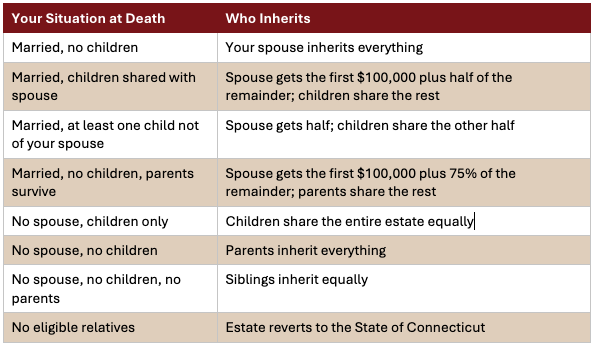
Notice what is not on that list: unmarried partners, close friends, stepchildren you never legally adopted, and charitable causes you cared about. Under Connecticut intestacy law, none of them inherit anything, regardless of how close your relationship was or what you intended.
The Probate Process Without a Will
Even when a will exists, Connecticut estates often go through probate. Without one, the process is almost always longer and more complicated.
Once a family member files a petition with the local Probate Court, the court schedules a hearing, appoints an administrator, and publishes a notice to creditors within 14 days of that appointment. The administrator then has two months to inventory all estate assets. Debts, taxes, and administrative expenses are paid first. What remains is distributed according to the intestacy formula above, subject to a final financial accounting hearing. The whole process typically takes at least 12 months from start to finish.
One important note: some assets pass entirely outside of the probate process regardless of whether you have a will. Life insurance proceeds, retirement accounts, jointly held property, and assets held in trust go directly to named beneficiaries or co-owners. Intestacy only governs what is left in your name alone.
The Surprises Families Don’t See Coming
The scenario that creates the most conflict is a blended family. If you are married and have children from a prior relationship, your spouse does not inherit everything. Your spouse receives half. Your children from outside the marriage receive the other half. That can mean the family home needs to be sold, or that your current spouse and your adult children from a previous marriage are suddenly co-owners of your estate.
Other common surprises include:
An unmarried partner receives nothing, no matter how long you lived together or how financially intertwined your lives were.
Stepchildren are not included unless you legally adopted them. They inherit only if there are no other eligible relatives.
Your estate could go to a relative you are estranged from if your closer relatives predecease you and you have no will in place.
A Will Changes Everything
A will is not a complicated document. It is a clear set of instructions that puts you in control of what happens to everything you have built. It names the person you trust to carry out your wishes. It protects your partner, your stepchildren, your friends, and the causes you care about. It can also name a guardian for minor children, which no intestacy statute will ever do for you.
The process of creating one does not have to take long. What matters is that it is done correctly under Connecticut law so that it holds up when your family needs it most.
Don’t Leave This Decision to Connecticut’s Default Rules
At The Prue Law Group, we have guided Connecticut families through estate planning and probate for over four decades. Attorney Patrick Prue’s more than 20 years of experience as a Connecticut probate judge gives our team a firsthand understanding of exactly what happens when someone dies without a plan in place. We know what families face inside the probate court, and we know how a well-drafted will changes that experience entirely.
If you do not have a will, or if yours has not been reviewed since a major life change, now is a good time to act.
Contact us today to schedule a consultation at any of our four conveniently located offices in Willimantic, Brooklyn, Coventry, and Colchester.
Sources:
- Connecticut General Statutes § 45a-437 (2024). Intestate succession: Distribution to spouse. Justia U.S. Law. https://law.justia.com/codes/connecticut/title-45a/chapter-802b/section-45a-437/
- Heritage Law. “What Happens When There Is No Will in Connecticut.” Updated August 2024. https://heritagelawct.com/what-happens-when-there-is-no-will-in-connecticut/
- Cohen and Wolf, P.C. “Probate Rights of a Surviving Spouse in Connecticut. “https://www.cohenandwolf.com/publication-probate-rights-of-surviving-spouses-in-Connecticut
- Lawrence & Jurkiewicz, LLC. “Probate 101: A Step-by-Step Guide to Administering an Estate in Connecticut. “https://www.lawjur.com/probate-101-a-clear-step-by-step-guide-to-administering-an-estate/
- Basche Law. “CT Probate FAQs. “https://baschelaw.com/ct-probate-faqs/
- Connecticut Probate Courts. “Probate Court User Guide: Administration of Decedents’ Estates.” https://www.ctprobate.gov/documents/user-guide-administration-of-decedents’-estates.pdf
- Nolo. “Intestate Succession in Connecticut: Who Inherits When There’s No Will?” https://www.nolo.com/legal-encyclopedia/intestate-succession-connecticut.html
- SmartAsset. “Guide to Connecticut Inheritance Laws.” Updated January 2026. https://smartasset.com/financial-advisor/connecticut-inheritance-laws
The Prue Law Group has served eastern and central Connecticut since 1980, providing comprehensive business law, estate planning, probate, and elder law services. Our team’s deep local knowledge and specialized expertise help business owners protect what matters most. AI may have been used for the initial research and drafting of the article. This content is intended for general informational purposes only and should not be construed as legal advice. For guidance on your specific situation, please contact our office for a consultation.
 https://pruelawgroup.com/wp-content/uploads/2026/09/September-Blog-Banners-thmb.png
1080
1080
Dunn Marketing
https://pruelawgroup.com/wp-content/uploads/2025/09/Prue-Law-logo_logo-color.svg
Dunn Marketing2026-09-24 15:34:092026-09-28 19:04:40September Is the Smartest Month to Start Your Estate Plan, Here’s Why
https://pruelawgroup.com/wp-content/uploads/2026/09/September-Blog-Banners-thmb.png
1080
1080
Dunn Marketing
https://pruelawgroup.com/wp-content/uploads/2025/09/Prue-Law-logo_logo-color.svg
Dunn Marketing2026-09-24 15:34:092026-09-28 19:04:40September Is the Smartest Month to Start Your Estate Plan, Here’s Why https://pruelawgroup.com/wp-content/uploads/2026/09/September-Blog-Banners-1500-x-500-px-2.png
1080
1080
Marci - Dunn Marketing
https://pruelawgroup.com/wp-content/uploads/2025/09/Prue-Law-logo_logo-color.svg
Marci - Dunn Marketing2026-09-11 17:56:322026-09-11 18:11:12What Connecticut’s Sandwich Generation Needs to Know About Elder Law
https://pruelawgroup.com/wp-content/uploads/2026/09/September-Blog-Banners-1500-x-500-px-2.png
1080
1080
Marci - Dunn Marketing
https://pruelawgroup.com/wp-content/uploads/2025/09/Prue-Law-logo_logo-color.svg
Marci - Dunn Marketing2026-09-11 17:56:322026-09-11 18:11:12What Connecticut’s Sandwich Generation Needs to Know About Elder Law https://pruelawgroup.com/wp-content/uploads/2026/08/Loss-of-Loved-one-blog-e1789164482409.png
1080
1080
Dunn Marketing
https://pruelawgroup.com/wp-content/uploads/2025/09/Prue-Law-logo_logo-color.svg
Dunn Marketing2026-08-03 15:01:442026-09-11 18:08:22When a Loved One Passes in Summer: A Connecticut Family’s Guide to Estate Settlement
https://pruelawgroup.com/wp-content/uploads/2026/08/Loss-of-Loved-one-blog-e1789164482409.png
1080
1080
Dunn Marketing
https://pruelawgroup.com/wp-content/uploads/2025/09/Prue-Law-logo_logo-color.svg
Dunn Marketing2026-08-03 15:01:442026-09-11 18:08:22When a Loved One Passes in Summer: A Connecticut Family’s Guide to Estate Settlement https://pruelawgroup.com/wp-content/uploads/2026/07/Prue-July-Blog-thumb-independence.png
1080
1080
Marci - Dunn Marketing
https://pruelawgroup.com/wp-content/uploads/2025/09/Prue-Law-logo_logo-color.svg
Marci - Dunn Marketing2026-07-02 14:54:112026-07-02 14:57:54What the 4th of July Can Teach You About Protecting Your Family’s Independence
https://pruelawgroup.com/wp-content/uploads/2026/07/Prue-July-Blog-thumb-independence.png
1080
1080
Marci - Dunn Marketing
https://pruelawgroup.com/wp-content/uploads/2025/09/Prue-Law-logo_logo-color.svg
Marci - Dunn Marketing2026-07-02 14:54:112026-07-02 14:57:54What the 4th of July Can Teach You About Protecting Your Family’s Independence https://pruelawgroup.com/wp-content/uploads/2026/06/Wedding-season-blog.png
1350
1080
Marci - Dunn Marketing
https://pruelawgroup.com/wp-content/uploads/2025/09/Prue-Law-logo_logo-color.svg
Marci - Dunn Marketing2026-06-06 16:44:142026-06-09 17:34:24“I Do” and What Comes Next: Estate Planning Essentials for Connecticut Newlyweds
https://pruelawgroup.com/wp-content/uploads/2026/06/Wedding-season-blog.png
1350
1080
Marci - Dunn Marketing
https://pruelawgroup.com/wp-content/uploads/2025/09/Prue-Law-logo_logo-color.svg
Marci - Dunn Marketing2026-06-06 16:44:142026-06-09 17:34:24“I Do” and What Comes Next: Estate Planning Essentials for Connecticut Newlyweds https://pruelawgroup.com/wp-content/uploads/2026/04/apr-thmb-estate-blog.png
1350
1080
Xo - Dunn Marketing
https://pruelawgroup.com/wp-content/uploads/2025/09/Prue-Law-logo_logo-color.svg
Xo - Dunn Marketing2026-04-01 21:23:062026-06-09 17:27:06Connecticut Families Should Know About Estate Planning and Taxes
https://pruelawgroup.com/wp-content/uploads/2026/04/apr-thmb-estate-blog.png
1350
1080
Xo - Dunn Marketing
https://pruelawgroup.com/wp-content/uploads/2025/09/Prue-Law-logo_logo-color.svg
Xo - Dunn Marketing2026-04-01 21:23:062026-06-09 17:27:06Connecticut Families Should Know About Estate Planning and Taxes https://pruelawgroup.com/wp-content/uploads/2026/03/March-2026-Prue-spring-clean.png
1350
1080
Marci - Dunn Marketing
https://pruelawgroup.com/wp-content/uploads/2025/09/Prue-Law-logo_logo-color.svg
Marci - Dunn Marketing2026-03-12 14:26:002026-06-09 17:27:28Spring Cleaning Your Estate Plan: Essential Documents to Review Before Tax Day
https://pruelawgroup.com/wp-content/uploads/2026/03/March-2026-Prue-spring-clean.png
1350
1080
Marci - Dunn Marketing
https://pruelawgroup.com/wp-content/uploads/2025/09/Prue-Law-logo_logo-color.svg
Marci - Dunn Marketing2026-03-12 14:26:002026-06-09 17:27:28Spring Cleaning Your Estate Plan: Essential Documents to Review Before Tax Day https://pruelawgroup.com/wp-content/uploads/2026/02/Feb-blog-estate.png
1080
1080
Xo - Dunn Marketing
https://pruelawgroup.com/wp-content/uploads/2025/09/Prue-Law-logo_logo-color.svg
Xo - Dunn Marketing2026-02-05 08:00:002026-06-09 17:28:09Why February is the Perfect Time to Update Your Estate Plan
https://pruelawgroup.com/wp-content/uploads/2026/02/Feb-blog-estate.png
1080
1080
Xo - Dunn Marketing
https://pruelawgroup.com/wp-content/uploads/2025/09/Prue-Law-logo_logo-color.svg
Xo - Dunn Marketing2026-02-05 08:00:002026-06-09 17:28:09Why February is the Perfect Time to Update Your Estate Plan